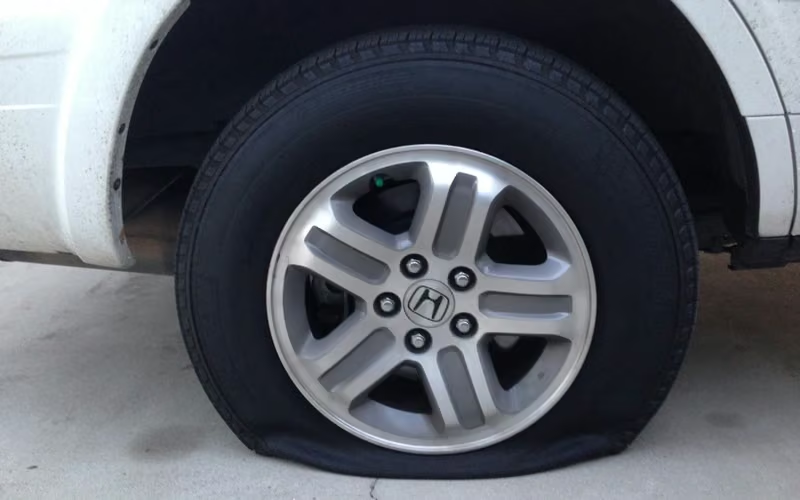
The short answer is no — not beyond the few metres it takes to get out of live traffic. A tyre that has lost its air is not a slightly worse tyre; it is a structural component doing a job it was never designed to do, and it degrades very quickly.
What actually happens when you drive on a flat
With no air pressure, the sidewall is carrying the entire weight of that corner of the car. It folds, unfolds and folds again with every wheel rotation. At 30 mph that is roughly ten times a second. The rubber and the casing cords inside heat up rapidly, and within a very short distance the internal structure begins to delaminate.
That is why a tyre driven on while flat cannot be repaired even if the original puncture was a tiny nail in the middle of the tread. The nail hole was repairable. The run-flat damage is not.
Beyond the tyre itself, you risk:
- Wheel damage. The rim ends up riding on the road surface. Alloys buckle and crack; that is a far bigger bill than a tyre.
- Suspension and steering damage. Shock loads through a collapsed tyre go straight into the hub, bearing and track rod.
- Brake and body damage. Shredding tread comes apart violently and can take out a wheel arch liner, brake line or sensor cable.
- Loss of control. Steering and braking on a flat are unpredictable, especially in the wet.
The legal position
Driving with a defective tyre is an offence. Each non-compliant tyre carries up to three penalty points and a fine, and with four defective tyres a driver can face disqualification. There is no exemption for "I was only going to the garage".
What to do instead
- Get somewhere safe first. Slow down gradually, do not brake hard, and steer to a lay-by, car park or side street. Travelling a short distance at very low speed to escape danger is the right call — the tyre is already beyond saving.
- Make yourself visible. Hazards on. At night or in poor visibility, a hi-vis vest before you get out.
- On a motorway, leave the vehicle. Exit on the left, get behind the barrier, and call 999 or use an emergency roadside telephone. Do not attempt to change a wheel on the hard shoulder. A mobile tyre fitter is not permitted to work there either.
- Anywhere else, assess the options. A usable spare or space-saver is the fastest route back on the road. No spare — which is most new cars — means a mobile fitter or recovery.
What about a space-saver spare?
Fine for exactly what it says: getting you to somewhere a proper tyre can be fitted. They are normally limited to 50 mph and a restricted distance, and they change the car's handling. Do not treat one as a long-term solution.
Run-flat tyres are the exception — up to a point
Run-flats have reinforced sidewalls designed to support the car with no pressure, typically for around 50 miles at up to 50 mph. Check your handbook for the exact figures, because they vary. Once a run-flat has been driven in deflated mode it should be replaced, not repaired.
If you are stopped and unsure what you are dealing with, a mobile fitter can come to the vehicle, assess it properly and either repair, replace or fit your spare on the spot.