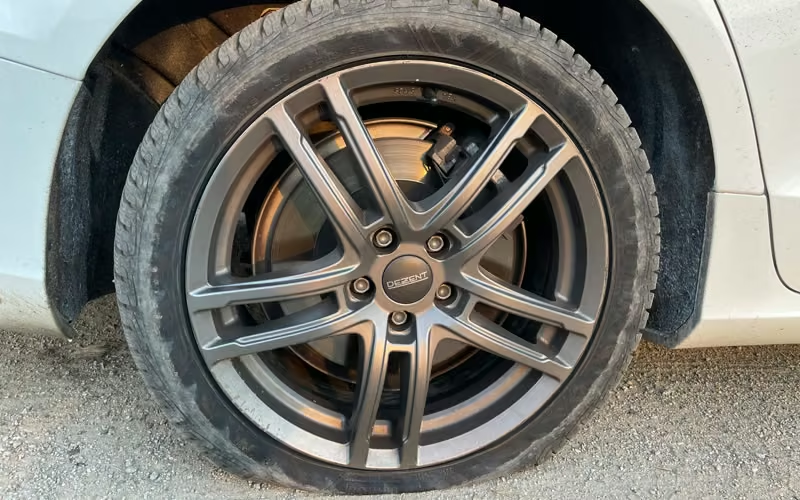
Every tyre carries its full specification on the sidewall. Once you know how to read it, ordering the right replacement becomes trivial — and you can spot when someone is about to fit you something that is not quite right.
A worked example: 225/45 R17 91W
225 — section width
The width of the tyre in millimetres, measured across the widest part of the inflated tyre. Must match what the vehicle manufacturer specifies.
45 — aspect ratio
The sidewall height as a percentage of the width. So 45% of 225 mm gives a sidewall about 101 mm tall. A lower number means a shorter sidewall — sharper steering, harsher ride, more vulnerable to potholes.
R — construction
"R" means radial. Almost every modern car tyre is radial. You may occasionally see "RF" or "ZR" on performance fitments.
17 — rim diameter
The wheel diameter in inches. This one is absolute: a 17-inch tyre only fits a 17-inch wheel.
91 — load index
A coded figure for the maximum weight the tyre can carry. 91 equals 615 kg per tyre. Never fit a lower load index than specified — it is an MOT failure and a real safety issue, particularly on vans, EVs and anything that carries weight.
W — speed rating
The maximum speed the tyre is rated for. Common ratings: T = 190 km/h (118 mph), H = 210 (130), V = 240 (149), W = 270 (168), Y = 300 (186). Fit the rating the manufacturer specifies or higher. Fitting lower can invalidate insurance.
Other markings worth knowing
- XL or Reinforced — a higher load capacity construction. If your car came with XL tyres, replacements must be XL.
- M+S, 3PMSF (the snowflake) — mud and snow, and certified severe snow performance respectively.
- DOT code — the last four digits give the week and year of manufacture. "2325" means week 23 of 2025.
- OE markings — MO (Mercedes), AO (Audi), * (BMW), N0–N6 (Porsche), AMS/MOE, etc. These are bespoke compounds developed for that manufacturer. Matching them is worth doing on cars that came with them.
- RSC, ROF, SSR, ZP, DSST — run-flat designations. If your car has run-flats and no spare, replacing them with standard tyres leaves you with no way home after a puncture.
- Rotation arrow / Outside — directional or asymmetric tyres that must be fitted a specific way round.
Where to find your size
- On the tyre sidewall — the definitive record of what is currently fitted, though not proof it is correct.
- The placard — a sticker in the driver's door shut, inside the fuel flap or in the glovebox. This is what the manufacturer specifies, along with pressures.
- The handbook.
Where the tyre and the placard disagree, the placard is right and someone has fitted the wrong thing.
Can I change size?
Only within limits, and only deliberately. Overall rolling diameter needs to stay within roughly 3% of standard or the speedometer, ABS and traction control all read incorrectly. Load index and speed rating must meet or exceed the original. And all four tyres — or at minimum both tyres on an axle — should match. On a four-wheel-drive car, mismatched circumferences can damage the transmission.
If you are unsure, enter your registration when you send a request and the fitter will confirm the correct specification for your exact vehicle.