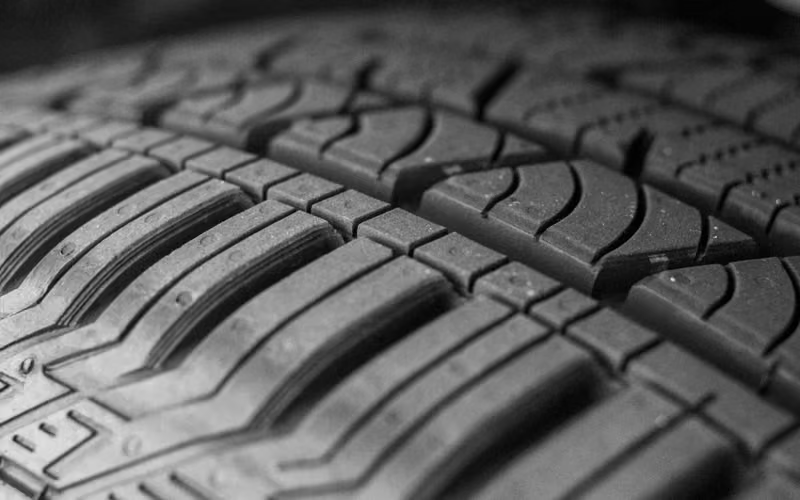
The legal minimum tread depth for cars, light vans and light trailers in the UK is 1.6 mm. That figure comes with two conditions that people often miss, and they matter.
The rule in full
The tread must be at least 1.6 mm:
- across the central three-quarters of the tread breadth, and
- around the entire circumference of the tyre.
So a tyre that measures 3 mm across most of its width but has worn to 1.2 mm on the inner edge of the central band is illegal. And a tyre with plenty of tread everywhere except one worn patch is illegal too. Uneven wear like that is usually a symptom of an alignment or suspension problem, which is worth investigating rather than just replacing the tyre.
Different vehicles have different limits — motorcycles over 50cc require 1 mm across three-quarters of the breadth, and heavy goods vehicles have their own requirements. The 1.6 mm figure above is the one that applies to ordinary cars and light vans.
What it costs to ignore
Up to three penalty points and a fine of up to £2,500 per tyre. With all four tyres below the limit, that is twelve points — enough for disqualification. Your insurer may also decline a claim if illegal tyres contributed to an accident.
The 20p test
The outer band of a 20p coin is roughly 3 mm wide. Insert one into a main tread groove: if you can see any part of that outer band, the tyre is likely close to or below 3 mm and needs checking properly. Do it at three points around the tyre and across the width, because wear is rarely even.
Tyres also carry moulded tread wear indicators — small raised bars in the base of the main grooves at 1.6 mm. When the tread is flush with those bars, the tyre is at the legal limit. Not near it. At it.
Why 1.6 mm is not the number to aim for
The legal minimum is where a tyre becomes an offence, not where it stops being safe. Wet braking performance falls away sharply below about 3 mm because there is far less groove volume to clear water. Independent testing has repeatedly shown wet stopping distances increasing substantially between 3 mm and 1.6 mm — on a wet motorway that difference is measured in car lengths.
Most fitters, and several road safety organisations, recommend replacing at 3 mm. That is a judgement call about risk and cost, not a legal requirement, but it is a sensible one — particularly on the tyres doing the steering.
Age matters too, not just depth
Rubber hardens and cracks with age regardless of mileage. The DOT code on the sidewall gives the week and year of manufacture — "0423" is the fourth week of 2023. Many manufacturers advise replacing tyres over ten years old whatever the tread looks like, and there are legal restrictions on tyres over ten years old being fitted to the front axles of certain buses, coaches and heavy goods vehicles. On a low-mileage car that has sat still, age is often the limiting factor, not wear.
Other things that fail regardless of tread
- Any cut longer than 25 mm or 10% of the section width, deep enough to reach the cords.
- A lump or bulge caused by separation or partial failure of the structure.
- Exposed cord or ply anywhere.
- An incorrect load index or speed rating for the vehicle.
- Mixing radial and cross-ply on the same axle.
If you are due replacements, a mobile fitter can do all four on your driveway while you get on with your day.